
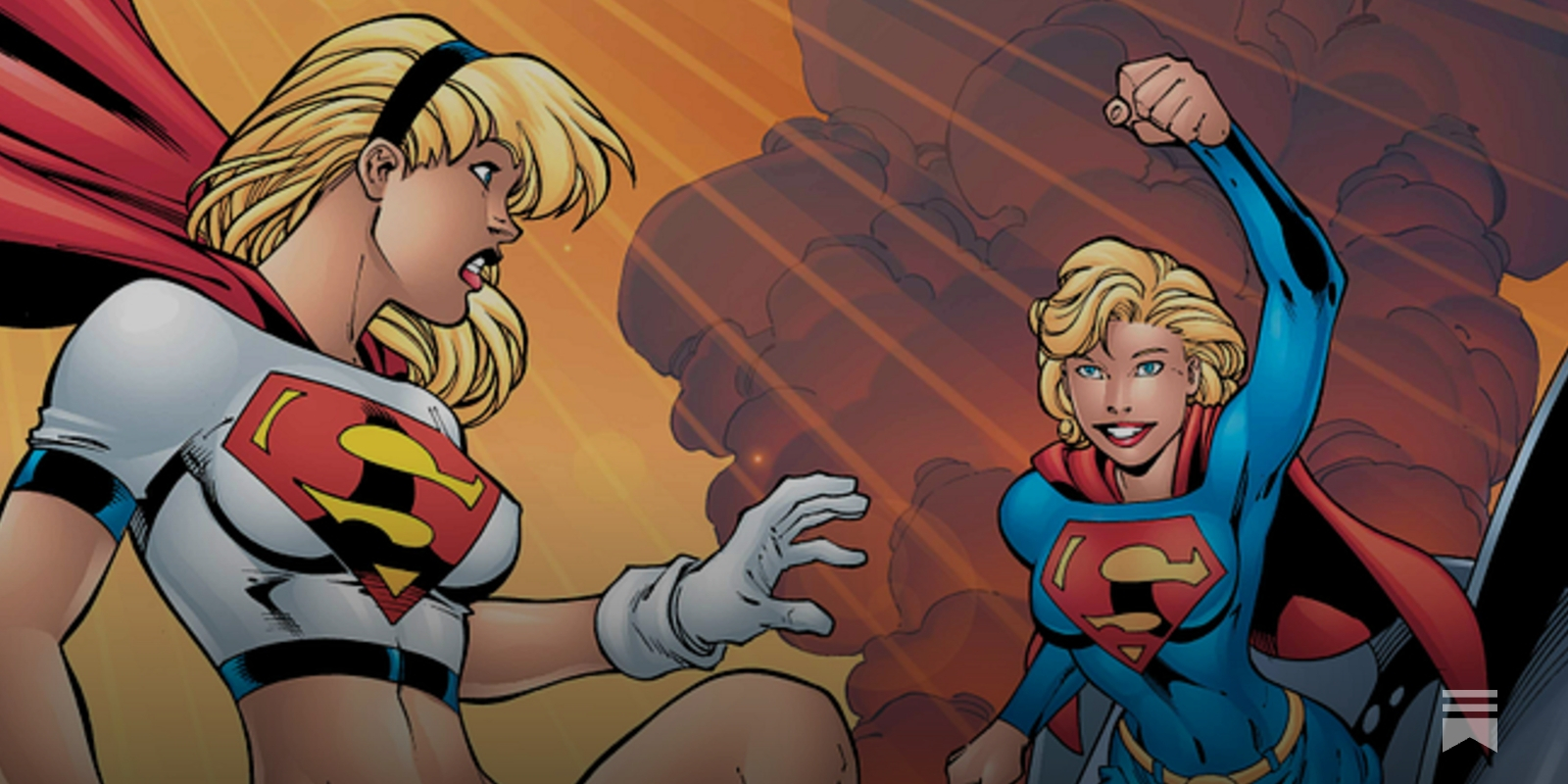
[#item_full_content] [[{“value”:”Yes, that’s a comic book panel. You probably thought this was going to be a film issue, because of the “Supergirl” movie. Sorry. It’s a comic book issue. Take it up with corporate.
Well, hey, this issue’s not not about “Supergirl,” the latest cinematic take on Superman’s younger, blonder cousin, starring Milly Alcock and directed by Craig Gillespie. It’s out in theaters this weekend; my friend Will and I caught an IMAX preview screening on Monday.
Alcock briefly appeared in James Gunn’s “Superman” movie last year. This marks the Girl of Steel’s first solo movie outing since the 1984 camp classic starring Helen Slater and Faye Dunaway. (I’ll let you guess which actress played Supergirl.) (Right, it was Faye.)
Subscribe
“Supergirl” builds on Kara Zor-El’s characterization in that film: messy, rough-and-tumble, perpetually hungover. The film finds Kara celebrating her 23rd birthday, in an “intergalactic alcoholism” way. So it goes, when you’re the only survivor of a dead planet who actually remembers their family. See, Superman came to Earth as a baby; Kara arrived as a teenager. Understandably, she eschews Kal-El’s famously optimistic outlook.
“He sees the good in everyone,” Kara says of her cousin, “and I see the truth.”
Kara aimlessly travels the stars with Krypto (the Superdog™), lingering in galaxies where her powers don’t work so she can get tremendously blotto. A young girl named Ruthye (Eve Ridley) crashes her pity party. Ruthye seeks vengeance on the space pirate who slaughtered her family, Krem (Matthias Schoenaerts, wearing an entire Hot Topic worth of studs on his face).
They immediately make this Supergirl’s problem, too. In Kara’s reluctant pursuit of an irredeemable man, she also wearily tries to divert Ruthye from her bloodlust. She knows what too much death can do to a girl. It involves a lot of alien whiskey.
Gillespie’s “Supergirl” borrows more from “Logan” than any previous “Superman” flick. Given this film’s rowdy sense of humor and space Western trappings, “True Grit” may be a better comparison. With a bit of death wish but competence not even kryptonite can kill, Alcock makes a fine Rooster Cogburn1 to Ridley’s Mattie Ross.
And listen: Alcock rules, even when the mostly satisfying “Supergirl” can’t quite keep up with her. Her star power: undeniable. The sci-fi production design: Mos Eisley cantina freaks as far as the eye can see. The pacing, though: baffling.
Screenwriter Ana Nogueira’s script liberally adapts its plot and characters from “Supergirl: Woman of Tomorrow,” a 2021 comic miniseries by writer Tom King and artist Bilquis Evely. Marketing for the film even touts that book as a jumping-on point for the comics curious.2
I like King and Evely’s mini just fine. But I’m a ’90s baby, baby. You can’t give the Maid of Might a grumpy disposition and an ingenue sidekick without talking about one of my favorite comic book bummers: “Many Happy Returns.”
Unfortunately, I have to get into a little bit of comic book lore. To stem your suffering, here’s an oversimplified history of a certain era of publication for Supergirl:
In the 1980s, Kara Zor-El died in a tragic, heroic sacrifice. Shortly thereafter, DC Comics rebooted the franchise and treated Kara as if she’d never existed.
Supergirl was still valuable I.P. The comic book company liked to sell comic books. So, in the 1990s, DC introduced a new, visually similar Supergirl character.
The star of this “Supergirl” comic book was not a Kryptonian refugee named Kara Zor-El. She was a (mostly) human girl named Linda Danvers with Superman-like superpowers, a traumatic past, and an attitude.
OK. That was like saying “Kim Kardashian made a video, and now she’s a businesswoman.” But we can move on.
By the early 2000s, sales on the “Supergirl” book were flagging. As a Hail Mary, writer Peter David and artist Ed Benes brought Kara Zor-El back—briefly, tragically—with the story arc “Many Happy Returns.” I trawled the comic book message boards back then. It was a huge deal, and it remains one of my favorite comics.
Through comic book-y machinations, Kara’s rocket from Krypton lands not in 1959 Metropolis, but in Linda’s then-present day world. And this really is the original Supergirl, brimming with all the winsome innocence that entails. She’s ill-equipped for Linda’s Bush-era world of fighting demons and baring midriffs.
In a turn right out of “Doctor Who,” the Supergirls learn a devastating truth. Kara died for a reason, so she must return to her original time, or else reality goes boom.
Linda can’t bear to send Kara to her fate. So, she tries to take her place. This goes well, until it goes so very, very poorly.
As a young teenager reading these issues soon after they came out, I had much in common with wide-eyed, well-meaning Kara. Now, I better appreciate Linda’s weary, stubborn desire to shield this kid from a universe that would rather see her die. Life, if you’re lucky, makes you into the person you should have had in that same scenario.
It’s gutting, operatic stuff, even if you don’t care about all the high-concept superheroics. So, most of y’all. In an introduction to the collected paperback edition of “Many Happy Returns,” David wrote:
The problem is … the world of comic book super-heroes, by and large, makes no inherent sense. … And the more we hammer away, the more problematic it becomes, to the point where many modern super-hero comics have an internal schism. It’s almost as if the stories come not from a childlike joy celebrating wish fulfillment, but instead an adult self-loathing, generated by a worldview that cannot accept the simple right and wrong, black and white morality in which super-heroes function best.
Adult self-loathing? Cannot accept the black and white morality in which super-heroes function best? Sounds like a certain major motion picture.
David died last year, and though fans remember his heady seven-year run on “Supergirl” fondly, DC hasn’t touched the Linda Danvers character in two decades. This story has become a “you had to be there” artifact with scant lasting impact on the franchise.
After watching Alcock raise hell in IMAX, though, I realized how much the movie shares with “Many Happy Returns.” They find similar truths at the character’s core. Both are about women who aren’t always nice, but who are kind. Both are stories about protecting someone who still has the soul you lost long ago. Both involve a sacrifice that doesn’t ask for trumpets—and sure as hell doesn’t get them, either.
Since DC brought the Kara Zor-El character back in the mid-2000s, they’ve increasingly roughened her edges, leaning on survivor’s guilt to distinguish her from her famous boy scout cousin. Probably inadvertently, they fulfilled the worst-case scenario imagined by “Many Happy Returns.” The Supergirl of 1959, as that story predicted, doesn’t work in a modern world.
Now, the movie crystallizes that notion, and I don’t think it’s a bad thing. An entire generation won’t know Supergirl as the pure-hearted naïf she was originally created to be, sure. But a jaded survivor doing her best to kick ass on the behalf of pure-hearted naïfs everywhere? I can fly with that.
(Read “Supergirl: Many Happy Returns” in digital form at DC Universe Infinite.)
Share
“Jinsei” (2026, dir. Ryuya Suzuki): An imperfect but hypnotic animated journey through the too-long life of a disaffected Japanese pop star—an unremarkably remarkable person. Once the story stretches into the future, it reminded me of Ari Folman’s “The Congress,” a movie I probably don’t like but that I think about all the time. (In theaters)
“Killer Nun” (1979, dir. Giulio Berruti): So efficiently titled. It’d be like if instead of “Titanic,” James Cameron called his movie “Boat Hole.” This is one of my new favorite examples of its kind of sordid thing (Italian people with a camera having a normal one). (Streaming on Tubi, Pluto TV, and more)
“Rope” (1948, dir. Alfred Hitchcock): Previously a gap in my Hitchcock log. Just as And They Were Roommates-core as I dreamed. Somehow, and at the risk of sounding dumb, I’ve never fully appreciated how many of Hitch’s best flicks rely on crazy formal swings. There’s the twist in “Psycho,” obvi, but also the single-setting claustrophobia of “Lifeboat,” and the single(ish)-take paranoia of “Rope.” Plus, the funniest line in cinema history is here: “Hello, champagne!” (Available to rent on digital)
“Fried Green Tomatoes” (1991, dir. Jon Avnet): Kathy Bates’ Evelyn reminds me of so many ladies I grew up around, including the cast of “Designing Women.” (Streaming on Netflix)
“Stop! That! Train!” (2026, dir. Adam Shankman): Crazy how RuPaul would have a couple Oscars by now if the apostle Paul had minded his own fucking business a couple millennia ago. (In theaters)
“Spice World” (1997, dir. Bob Spiers): Comedic timing, ranked from best to Victoria … 1) Mel C. 2) Geri 3) Mel B. 4) Emma 5) The bus 6) Victoria (Not officially streaming)
Subscribe
[
](https://byericwebb.substack.com/p/the-death-of-robin-hood-movie-review-hugh-jackman-a24-watch-michael-sarnoski-jodie-comer-bill-skarsgard-myth-legend-real)
[
I like to imagine my own funeral
](https://byericwebb.substack.com/p/the-death-of-robin-hood-movie-review-hugh-jackman-a24-watch-michael-sarnoski-jodie-comer-bill-skarsgard-myth-legend-real)
Eric Webb
·
Jun 17
[
Read full story
](https://byericwebb.substack.com/p/the-death-of-robin-hood-movie-review-hugh-jackman-a24-watch-michael-sarnoski-jodie-comer-bill-skarsgard-myth-legend-real)
[
](https://byericwebb.substack.com/p/superman-review-movie-james-gunn-dc-david-corenswet)
[
This Superman movie punches fascists
](https://byericwebb.substack.com/p/superman-review-movie-james-gunn-dc-david-corenswet)
Eric Webb
·
July 8, 2025
[
Read full story
](https://byericwebb.substack.com/p/superman-review-movie-james-gunn-dc-david-corenswet)
Writer Caroline Siede identifies a quietly revolutionary idea behind our new favorite TV show, with “Widow’s Bay reclaims the spinster.”
From The A.V. Club:
It turns out that in a spooky island town haunted by curses, monsters, and great sight gags, the person you can most trust to get the job done is an unmarried, mid-life (or older), childfree woman—the sort who at one point might have dismissively been referred to as a “spinster.”
Read it here.
…
Eternally an Erika Alexander fan (stream “Living Single” on Hulu), so The A.V. Club’s tour through her myriad roles really delighted me. Side note … I need a spin-off for her preacher character from “Is God Is,” expeditiously.
Read it here.
…
Ta-Nehisi Coates’ reckoning with Kamala Harris’ silence on Gaza got me good. For Vanity Fair, he methodically stacks next to each other the Democrats’ reverence for civil rights heroes at home and their coddling of imperialism abroad. This town isn’t big enough for both of them.
I know it’s cheating to excerpt a piece’s closing line, but, banger: “And if their children have come only to praise, not check, empire, then why have they come at all?”
Read it here.
1
Unfortunately, Milly Alcock never delivers the line, “Fill your hand, you son of a bitch!”
2
I caught at least one Easter egg in the movie: The ladies visit the planet Bilquis, named after the award-winning “Woman of Tomorrow” artist.”}]]  Read More